
Shkodra: A City of Music, Art, and Heritage
Nestled between the majestic Albanian Alps and the shimmering waters of Lake Shkodra, the city of Shkodra (Shkodër) is one of Albania’s oldest and most culturally rich urban centers. Known as the cradle of Albanian art, literature, and music, Shkodra has played a pivotal role in shaping the nation’s artistic identity.
With a history that dates back over 2,400 years, Shkodra has been influenced by Illyrian, Roman, Byzantine, Ottoman, and Venetian cultures, creating a uniquely diverse and vibrant cultural landscape. This melting pot of civilizations has made Shkodra a hub for music, poetry, and intellectual movements, where creativity has thrived in every corner of the city.
One of Shkodra’s most remarkable contributions to Albanian musical heritage is Ahengu Shkodran, an urban musical genre that embodies the city’s elegance, refinement, and poetic soul. From the cobblestone streets of its historic neighborhoods to the lively atmosphere of its traditional taverns, Ahengu has been the soundtrack of Shkodrans’ joys, sorrows, and celebrations for generations.
The Origins and Evolution of Ahengu Shkodran
Unlike many other Albanian folk music genres, Ahengu was not directly derived from rural traditions. Instead, it was shaped by the multicultural influences that defined Shkodra, a city historically known as a bridge between the East and the West.
Ahengu’s melodic foundation was deeply influenced by Oriental maqam scales, but the Shkodran musicians, known as ahengxhinjtë, transformed these melodies, adapting them to their own stylistic and poetic traditions. Through time, this adaptation led to a rich and elegant musical genre, distinct from any other Albanian music.
Ahengu Shkodran became the soul of the city, performed under the shade of mulberry trees, in vibrant courtyards, and later on professional stages. As its popularity grew, it became a symbol of refinement and artistic sophistication, cherished by the people of Shkodra and beyond.
The Cultural Heart of Albania: Shkodra and its Artistic Spirit
Shkodra is not only famous for its music but also for its deep-rooted artistic and intellectual traditions. As the birthplace of some of Albania’s greatest poets, musicians, and writers, the city has always been a center for education and artistic innovation.
✔ Rozafa Castle – A legendary fortress that overlooks the city, where history and folklore intertwine.
✔ Marubi National Museum of Photography – Home to Albania’s first and most iconic photographic collection, showcasing over 500,000 historical images.
✔ Shkodra’s Old Bazaar – Once a vibrant marketplace where merchants, artists, and musicians gathered to share ideas and showcase their crafts.
✔ Theater “Migjeni” – One of the oldest and most prestigious theaters in Albania, a stage for Ahengu performances, classical music, and modern artistic productions.
Shkodra’s musical and literary heritage is further enriched by its deep connection to nature, with Lake Shkodra, the Buna River, and the surrounding mountains inspiring poets, musicians, and artists alike.
The Musical Instruments of Ahengu Shkodran
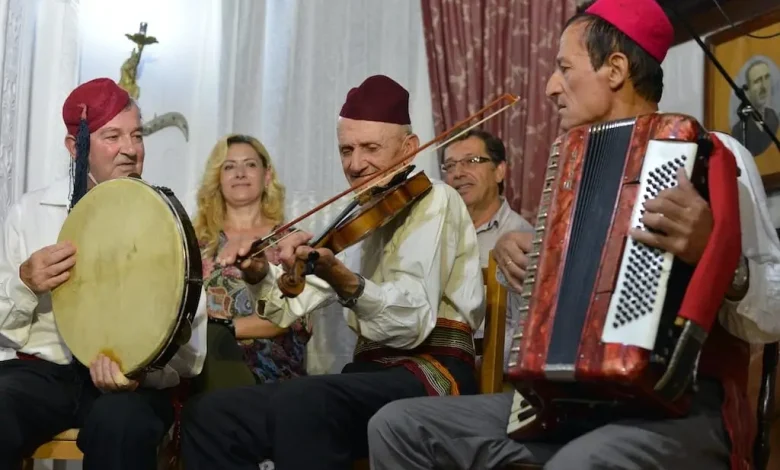
Ahengu’s characteristic sound is defined by a select group of traditional instruments, each playing a crucial role in shaping its distinctive melodic and rhythmic flow:
✔ Sazja – A ten-stringed instrument with Oriental origins, leading the melody and setting the tone of the song.
✔ Qemane (Violin) – Adding a soft, expressive sound that enhances the emotional depth of the music.
✔ Dajre (Tambourine) – Providing a gentle yet defining rhythmic beat, maintaining the elegant tempo of Ahengu.
Among these instruments, sazja played the most vital role, particularly in guiding the melody and setting the emotional tone of the performance. Its use in Ahengu lasted for nearly 150 years, marking it as an indispensable part of Shkodra’s musical identity.
The Legacy of Ahengu Shkodran – A Collection of Iconic Songs
Ahengu Shkodran is celebrated for its vast repertoire of poetic and melodious songs, each carrying a distinct story, emotion, or social reflection. The lyrics often explore themes of love, nostalgia, joy, and sorrow, woven into melodic structures that evoke deep emotional responses.
Some of the most iconic Ahengu songs include:
- Pranvera filloi me ardhë.
- O bylbyl, o more i mjerë.
- Dashnuer t’u bana. (Fjalët dhe muzika Hazan Preza)
- Të gëzojmë se erdh pranvera. (Fjalët dhe muzika Hazan Preza)
- Dalin vajzat prej mejtepit. (Fjalët dhe muzika Hazan Preza)
- Shkoj e vi flutrim si zogu. (Fjalët dhe muzika Hazan Preza)
- Moj e vogël si floriri. (Fjalët dhe muzika Alush Beqari)
- Oh! N’atë fushë t’mejdanit
- Vaj si kenka ba dyrnjaja. (Fjalët dhe muzika Ndrekë Vogli-Naraçi)
- Metelikun ta kam fal
- Hylli qi del n’sabah
- Moj fëllanxë qi rrin në kafaz
- Karajfilat qi ka Shkodra
- Kur fillon drita me dalë
- Balli yt prenvera. (Fjalët dhe muzika Nush Pali)
- Nji tubë drandofille po të çoj
- Kanga e Gjyles
- Karajfil në kodër. (Fjalët dhe muzika D. Zef Shestani)
- Sa me t’shpejtë ma vune kamben. (Fjalët dhe muzika Ejell Çeka)
- Karajfili në saksi
- Karajfil të zgodha
- Në pranverë që kena hi. (Fjalët Kolë Gurashi, muzika Nush Pali)
- M’i gëzofsh pesëmbëdhetë pranverat
- Moj e mirë synin larushë
- Pse ti lule rri mshehun
- Çile atë zemër plot kujtime. (Fjalët dhe muzika Paulin Pali)
- Drandofille me shumë erë
- Ç’u këputa unë e mjera
- Karajfili kuq si gjaku
- Jelino. (Fjalët dhe muzika Ramadan Sokoli)
- Vashës. (Fjalët dhe muzika Frano Jakova)
- K’ndon bylbyli poshtë te zalli. (Fjalët dhe muzika Karlo Pali)
- K’ndo bylbyl me t’madhin za. (Fjalët dhe muzika Karlo Pali)
- Bylbyli në pranverë
- Tash ka çilë pranvera
- Dielli sa të ketë prendue. (Fjalët dhe muzika Paulin Pali)
- Mori drandofillja e vogël
- Moj e bukur tash sa vjet
- Çka kanë sytë e mi qi kjajnë
- Ma ke gishtin për unazë. (Fjalët Tefë Krroqi, muzika Tonin Rrota)
- Tash sa dit e mot
- Jargavan me bojë për mall. (Fjalët Simon Çurçija, muzika Ndrekë Vogli-Naraçi)
- Ti moj Shkodër, Shkodra jonë. (Fjalët dhe muzika Gasper Zadeja)
- Syn’ e zi si mereqepi
- As aman moj Gjyla e Rremit
- Jar te due, mori të due
- Marshall bukurisë sate. (Fjalët dhe muzika Palokë Kurti)
- Për mue paska kenë kismet. (Fjalët dhe muzika Palokë Kurti)
- Kenka nuri i bukurisë. (Fjalët dhe muzika Bejto Halili)
- Po ti çka i ke thanë dikujt
- Hije t’bajshin ty qerpikët
- Dola në penxhere
- Moj fellanxë e malit
- Nji lule qi mka cilë tash
- Bishtalecat palë-palë
- Syni yt porsi ullini
- Bakushes
- S’ka ma t’bukur se pranvera. (Fjalët dhe muzika Rud Gurashi)
- Me pak bejta due me t’thanë
- Kur t’i shof dy ytë e shkruem
- Kur më del në derë
- Kur fillon drita me dalë
- Si t’kam dashtë unë ty
- Njata sytë e zezë, o të zezë
- Pranverë, pranverë. (Fjalët dhe muzika Namik Mithi)
- Pranvera me dalë ka fillue. (Fjalët dhe muzika Nush Pali)
- N’Shkodër tonë ka ra nji dritë. (Fjalët dhe muzika Palokë Kurti)
- Krisi topi. (Fjalët dhe muzika Hysen Dobraçi)
- Kur më flet me gojë moj Gjyle
- Kanga e Oso Kukës. (Fjalët dhe muzika Zenel Maha)
- Kanga e Ali Pashë Tepelenës
- Ti je krejt si nji ganxhe. (Fjalët dhe muzika Paulin Pali)
- Në gjergjef vasha tue qendisë. (Fjalët dhe muzika Ramadan Sokoli)
- Sillet moti për së mbarit. (Fjalët dhe muzika Marku i Kranjanes)
- Kanga e Dedë Gjo’Lulit
- Midis t’ballit m’kenji pikë
- Sa e kandshme vjollcë ti je. (Fjalët dhe muzika Paulin Pali)
- Në nji kopsht t’bukur unë e mblodha. (Fjalët dhe muzika Paulin Pali)
- As aman moj lulja e Allit
- Po ta marr kangen me saze. (Fjalët dhe muzika Mani Zylkos)
- Ani ma ven doren permbi dorë
- Hajde mori vashë se na erdhi vera
- Ala emnin s’ta kam xanë. (Fjalët dhe muzika Ndrekë Vogli-Naraçi)
- Çka ke vashë qi m’je habitë
- Çou moj vashë
- Karajfili kuq si gjaku. (Fjalët dhe muzika Sait Hoxha)
- Pranverë e bukur
- Mori vjollcë qi çilë n’pranverë
- Kur të pashë moj lule. (Fjalët dhe muzika Paulin Pali)
- Shumë pranvera po kalojmë. (Fjalët dhe muzika Karlo Pali)
- Si dukat i vogël je
- Si t’kam dashtë unë ty
- Me dymbëdhjetë mekame qi janë.
- T’dilen nade n’sabahile. (Muzika Kasem Xhuri)
- Jare, iptida due me fillue. (Fjalët Jonuz Shiroka, muzika Gjok Kraja)
- Me dy tri pikali në faqe
- Hajde verë e bardha verë
- Ganxhet tuja me shumë erë
- Të kam dashtë dhe prap të due. (Fjalët dhe muzika Karlo Pali)
- Venma dorën përmbi dorë
Preserving the Legacy of Ahengu Shkodran
As part of Albania’s urban musical heritage, Ahengu Shkodran represents a vital link between past and present, a testament to the artistry, poetic sensitivity, and cultural refinement of Shkodra.
Organizations like Votra Magazine play a crucial role in documenting, promoting, and reviving these musical traditions, ensuring that future generations can continue to appreciate and engage with the richness of Albania’s musical past.
How You Can Support and Experience Ahengu Today
✔ Attend cultural events and festivals dedicated to preserving Albanian musical traditions.
✔ Explore digital archives where classic Ahengu performances are available.
✔ Encourage younger generations to learn about and appreciate this unique musical style.
✔ Support traditional musicians and projects that aim to keep Ahengu alive.
More than just a genre, Ahengu Shkodran is a symbol of Albania’s rich musical past, a tradition that continues to captivate and inspire those who hear its melodies. As long as its songs are sung and its music is played, Ahengu will remain an integral part of Albania’s cultural heritage.
Discover More About Ahengu Shkodran with Votra Magazine! – Your Guide to Albania’s Musical Traditions.